
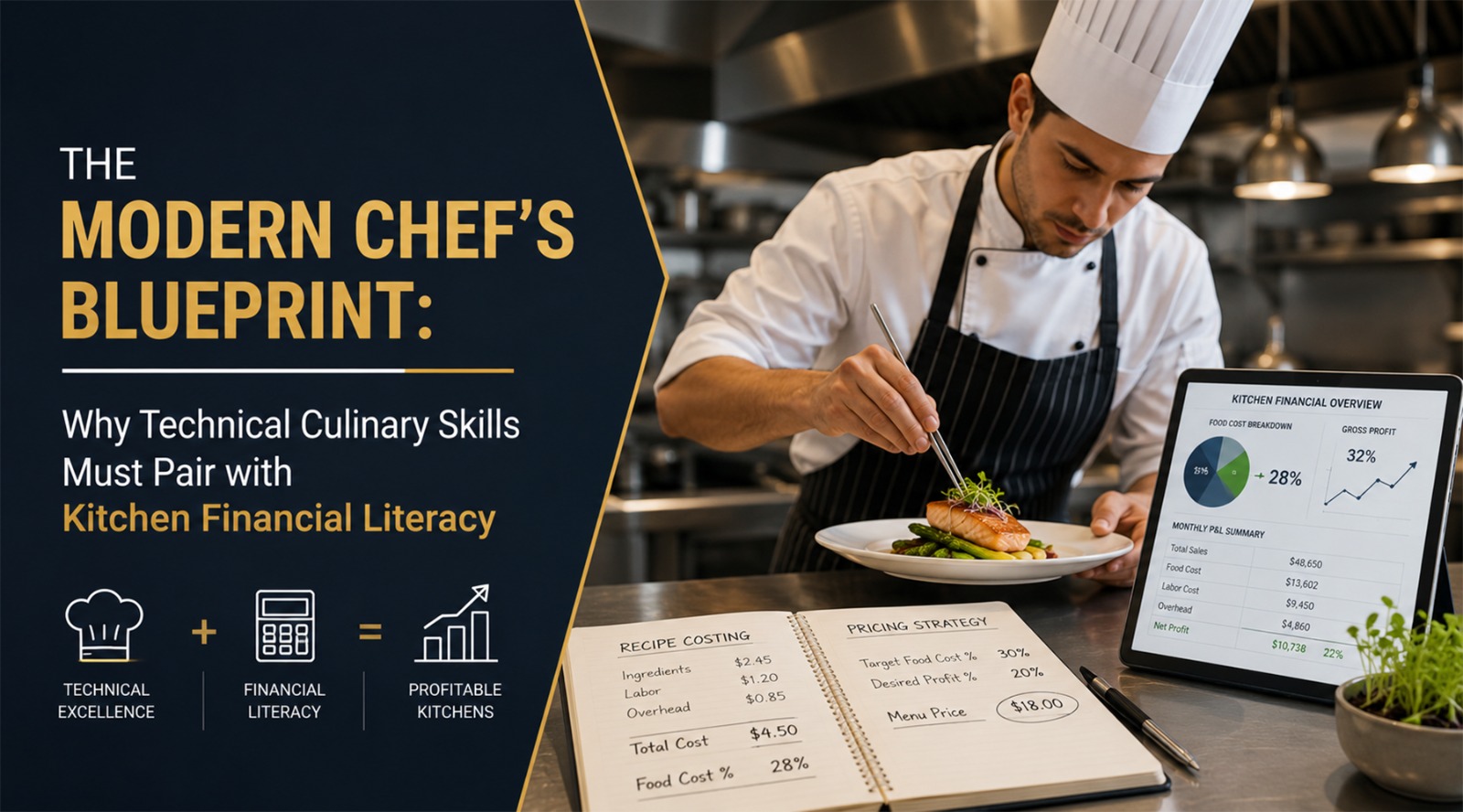
For decades, culinary careers were largely defined by craftsmanship. A chef's reputation depended on technical precision, consistency, creativity, and the ability to execute dishes at the highest standards. While these fundamentals continue to form the backbone of professional cooking, the expectations placed on culinary professionals are changing rapidly.
Today's hospitality industry demands more than culinary expertise alone. Kitchens operate within highly competitive business environments where profitability, resource utilization, menu performance, and operational efficiency directly influence success. As a result, the modern chef is expected to understand not only how food is prepared but also how food businesses function.
This shift is redefining culinary career development and creating a new blueprint for future hospitality professionals.
The Kitchen Is No Longer Isolated from Business Strategy
In many hospitality organizations, kitchens were once viewed primarily as production centers responsible for delivering food quality and consistency. Financial planning, budgeting, and profitability were often considered management responsibilities that existed outside the culinary environment.
That distinction has become increasingly blurred.
Today, decisions made within the kitchen influence purchasing costs, labor allocation, inventory management, waste reduction initiatives, and overall business performance. A single menu change can impact procurement strategies, staffing requirements, and guest spending patterns.
As hospitality businesses become more commercially focused, chefs are expected to contribute to conversations that extend beyond food preparation.
Students pursuing international hospitality management qualifications are increasingly exposed to this reality as hospitality education evolves to reflect changing industry expectations.
Why Financial Awareness Is Becoming a Culinary Advantage
Technical culinary skills remain essential. However, the ability to understand the financial implications of kitchen decisions is becoming a significant differentiator.
Consider menu development. Creating an appealing dish requires creativity and technical knowledge. Yet successful menu planning also requires an understanding of ingredient costs, supply availability, preparation efficiency, and revenue contribution.
In a similar vein, quality concerns are no longer the only factors taken into account while making purchases. Chefs have to assess long-term sustainability, value, consistency, and supplier dependability.
Professionals who can balance culinary excellence with financial awareness often contribute more effectively to business objectives.
This growing emphasis on commercial understanding is influencing programs in international hotel management and international hospitality and tourism management, where operational and business disciplines increasingly intersect.
Understanding the Financial Impact of Everyday Decisions
Many of the decisions made during daily kitchen operations carry financial consequences that are not immediately visible.
- Portion control affects food cost percentages.
- Inventory management influences waste levels.
- Production planning impacts labor efficiency.
- Supplier selection affects consistency and profitability.
When considered separately, these choices could seem ordinary. When taken as a whole, they influence the financial stability of a food and beverage business.
Modern chefs are expected to recognize these connections and make informed decisions that support both culinary standards and commercial performance.
This broader perspective is helping transform culinary leadership across hospitality businesses worldwide.
The Evolution of Menu Development
Menu creation has become one of the clearest examples of how culinary and financial considerations now work together.
Historically, menus are designed in such way to driven primarily by culinary vision and guest preferences. While these factors remain important, operators are increasingly evaluating menus through a wider business lens.
Questions now extend beyond taste and presentation:
- How sustainable is the ingredient supply?
- What preparation resources are required?
- How does the item contribute to overall profitability?
- Does it align with guest demand patterns?
- Can consistency be maintained at scale?
This evolution requires chefs to think strategically while maintaining creativity.
Students enrolled in an international hotel management course are increasingly learning how menu planning influences broader operational outcomes within hospitality organizations.
Waste Reduction Is a Leadership Responsibility
Food waste has become a major area of focus across the hospitality industry.
Beyond environmental considerations, waste directly affects operational performance and financial results. Every unused ingredient represents lost resources, including purchasing costs, labor investment, storage capacity, and potential revenue.
Leading culinary teams are responding by adopting more efficient inventory practices, refining production planning processes, and improving ingredient utilization.
Chefs who understand how operational decisions influence business performance are often better positioned to contribute to long-term organizational success.
The Growing Importance of Commercial Leadership
As hospitality businesses become increasingly complex, culinary professionals are finding themselves involved in broader strategic discussions.
Senior management, operations directors, finance teams, and procurement departments often work together with executive chefs. Budgeting, forecasting, resource planning, and company growth are among their duties, which frequently go beyond kitchen supervision.
This evolution is creating demand for professionals who possess both technical competence and commercial understanding.
Graduates of bachelor of international hospitality management and bsc international hospitality management programs are increasingly recognizing that leadership opportunities often emerge from the ability to connect operational expertise with business objectives.
Global Hospitality Demands Broader Capabilities
The international hospitality sector operates in diverse markets with varying consumer expectations, economic conditions, and operational challenges.
Professionals working within international hospitality and tourism management environments must often balance culinary innovation with commercial realities. Success depends not only on delivering exceptional food experiences but also on maintaining sustainable business performance.
This global perspective explains why employers increasingly value candidates who understand both culinary operations and financial management.
Students pursuing international hospitality course, diploma in international hotel management, or international diploma in hotel management qualifications are often encouraged to develop skills that support both areas.
Preparing for the Future Culinary Landscape
The culinary profession is entering a period of transformation.
Restaurants, hotels, resorts, and hospitality businesses are operating within environments where efficiency, profitability, and adaptability are becoming increasingly important. Technical expertise remains essential, but it is no longer the sole measure of professional success.
The chefs who thrive in this environment will be those who understand how culinary decisions influence business outcomes.
Restaurants, hotels, resorts, and hospitality businesses are operating within environments where efficiency, profitability, and adaptability are becoming increasingly important. Technical expertise remains essential, but it is no longer the sole measure of professional success.
The chefs who thrive in this environment will be those who understand how culinary decisions influence business outcomes.
This broader understanding extends across multiple operational areas where culinary professionals increasingly contribute beyond food preparation alone.
Operational decisions made inside the kitchen now influence business performance in measurable ways. Purchasing strategies, supplier relationships, labor planning, waste management, menu engineering, and inventory control all connect directly to financial outcomes.
As hospitality organizations continue adapting to changing consumer expectations and competitive pressures, culinary professionals are expected to participate more actively in strategic decision-making processes.
Educational institutions are responding by integrating commercial awareness, operational management, and leadership development into hospitality curricula alongside traditional culinary training.
Graduates entering the industry increasingly recognize that career growth opportunities often emerge through the ability to combine technical capability with broader business understanding.
This evolution reflects wider changes taking place throughout hospitality, where operational excellence and commercial performance are becoming increasingly interconnected.
The future culinary landscape will continue rewarding professionals who can maintain high culinary standards while contributing to business sustainability, operational efficiency, and long-term organizational success.
As the industry continues to evolve globally, chefs who develop both culinary expertise and commercial awareness will be better positioned to lead teams, support business objectives, and create sustainable hospitality experiences for the future.