
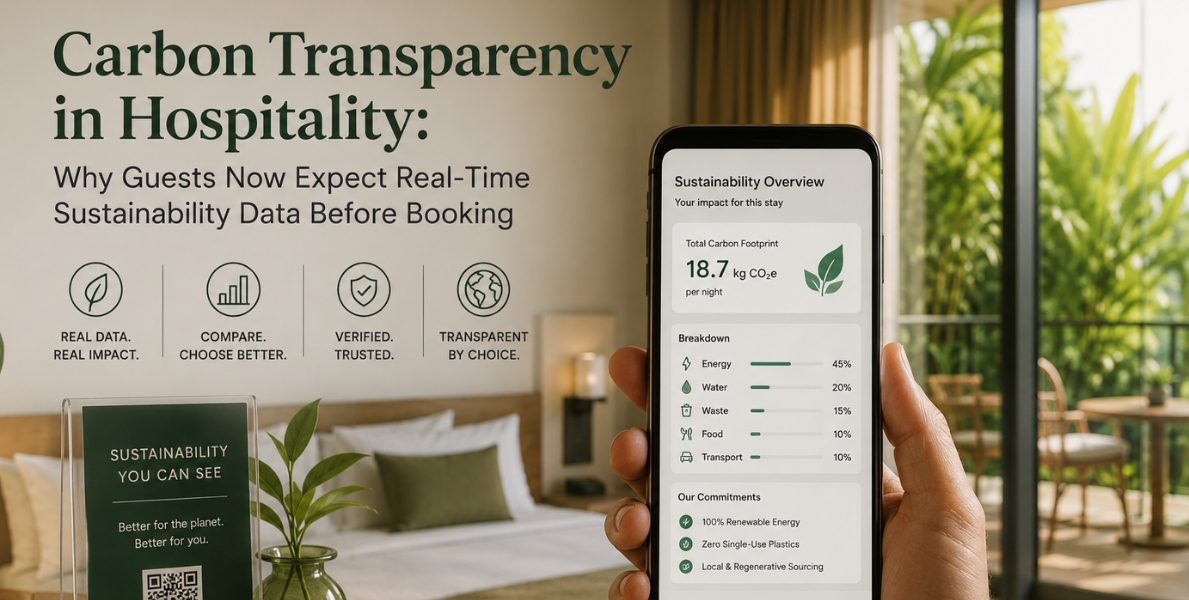
The hospitality industry has crossed a critical threshold. There was a time when a "sustainable hotel" could validate its eco-credentials simply by hanging a placard in the bathroom asking guests to reuse towels, or by displaying a vague, third-party green certification logo on its website.
In 2026, that is no longer enough.
Today's travelers are highly sophisticated, tech-savvy, and deeply skeptical of vague environmental claims. Greenwashing is easily unmasked by a generation of consumers who demand proof. The modern traveler doesn't want promises about what a hotel plans to achieve by 2030; they want to see what that property is achieving right now. This demand has given rise to a new industry standard: real-time carbon transparency.
To thrive in this landscape, future industry professionals must understand how data, technology, and guest expectations intersect. Aspiring leaders looking to master these modern dynamics are increasingly turning to a hotel management international course to build the foundational skills required for this data-driven era.
The Rise of the Quantifiable Traveler
The shift toward real-time sustainability data is driven by a profound change in consumer behavior. Modern travelers are calculating their personal carbon footprints with precision, tracking everything from their flights to their daily meals. When they book accommodation, they expect that same level of granularity.
Guests now look for specific metrics during the booking process:
- Real-time energy consumption: How much of the hotel's current power is derived from onsite renewable sources versus the grid?
- Live water-stress metrics: How efficiently is the property managing its water lifecycle, especially in areas prone to drought?
- Dynamic carbon cost per night: What is the exact carbon footprint associated with an individual room night, factoring in current occupancy rates and seasonal energy loads?
This data is no longer hidden away in an annual corporate social responsibility (CSR) report. It is integrated directly into booking engines, OTAs (Online Travel Agencies), and room selection screens, allowing guests to filter their options based on real-time ecological efficiency.
Operational Excellence: The Back-of-House Evolution
Achieving true carbon transparency requires a flawless back-of-house operation. Every department, from engineering to environmental services, must function as a synchronized, resource-efficient unit. If a hotel promises real-time waste reduction or chemical-free cleanliness, the execution on the floor must be immaculate.
This operational precision is heavily reliant on trained accommodation and environmental services teams. For example, maintaining strict eco-standards in a high-density urban environment requires specialized operational knowledge. Professionals who hold a diploma in housekeeping management in Kolkata are trained to manage resource allocation, implement zero-waste cleaning protocols, and utilize smart property management systems that log consumption data seamlessly. Without this meticulous attention to detail at the ground level, the data shown to guests on the front-end would quickly fall apart.
How Technology Enables Real-Time Transparency
The ability to display live sustainability data relies on a robust ecosystem of connected technologies:
1. IoT and Smart Metering
Internet of Things (IoT) sensors are the backbone of the transparent hotel. These sensors track water flow, monitor HVAC efficiency, and measure electricity usage in real time across different zones of the property.
2. Blockchain and Immutable Ledgers
To combat skepticism, forward-thinking hotels use blockchain technology to log their sustainability metrics. Because data on a blockchain cannot be retroactively altered, it provides an unassailable audit trail. A guest can scan a QR code in their room and see an immutable record of the hotel's supply chain, food sourcing, and carbon offsets for that exact day.
3. Open API Integration
Hotels are increasingly linking their property management systems (PMS) via open APIs to corporate travel booking platforms. This allows corporate travel managers—who are bound by strict corporate net-zero targets—to instantly verify whether a hotel meets their company's environmental compliance standards before making a bulk booking.
Regional Adaptation and the Global Talent Pipeline
The demand for carbon transparency is not limited to major western hubs; it is a global movement shaping tourism across diverse ecosystems. In regions known for ecological vulnerability and rapid tourism expansion, such as Northeast India, the integration of technology and sustainable management is vital.
Educational institutions in these areas are completely reshaping their curricula to keep pace. Students enrolled in hotel management courses in Guwahati are learning that their future roles will involve far more than traditional guest relations. They are being trained to manage eco-lodges and urban hotels that protect regional biodiversity while leveraging data platforms to prove their low-impact status to international tourists exploring the region.
Shifting Metrics: Evaluating Success in 2026
The focus on live transparency has fundamentally altered how hotels measure operational success. Traditional business metrics are now directly paired with environmental indicators to provide a complete picture of performance.
Instead of looking solely at financial milestones like the Average Daily Rate (ADR) or Revenue Per Available Room (RevPAR), modern operators monitor the Carbon Intensity per Occupied Room (CIOR). Similarly, generic Guest Satisfaction Scores (GSS) are now bolstered by real-time operational transparency, such as public dashboards tracking live food waste diversion percentages and the property's reliance on self-generated renewable energy.
The Commercial Advantage of Radical Honesty
Some hoteliers worry that displaying real-time data could backfire if a property has a less-than-perfect day—for instance, if an anomaly causes energy usage to spike. However, data from 2026 consumer trends shows that modern travelers prize honesty over artificial perfection.
Properties that display their live data openly—including the days they fall short of their targets—build immense brand loyalty. It shows a commitment to radical transparency. Furthermore, it invites the guest to be part of the solution. When a hotel displays a live dashboard showing that the local grid is under stress, guests are far more likely to voluntarily adjust their thermostat settings or opt out of daily linen changes. This transforms the guest from a passive consumer into an active partner in conservation.
The Path Forward for Future Hoteliers
As real-time carbon data transitions from a premium feature to a baseline expectation, the industry will require a new generation of leaders who are equal parts hospitality experts, data analysts, and environmental advocates.
Whether an individual begins their career by mastering the foundational global standards of an international hotel management course, refines their operational expertise through localized training like a diploma in housekeeping management in Kolkata, or studies regional eco-preservation through hotel management courses in Guwahati, the mandate remains identical.
The future of hospitality belongs to those who can operate with absolute transparency. By opening up their data cupboards and showing guests the real-time reality of their operations, hotels can move past the era of empty promises and usher in a new age of verified, trust-based travel.