
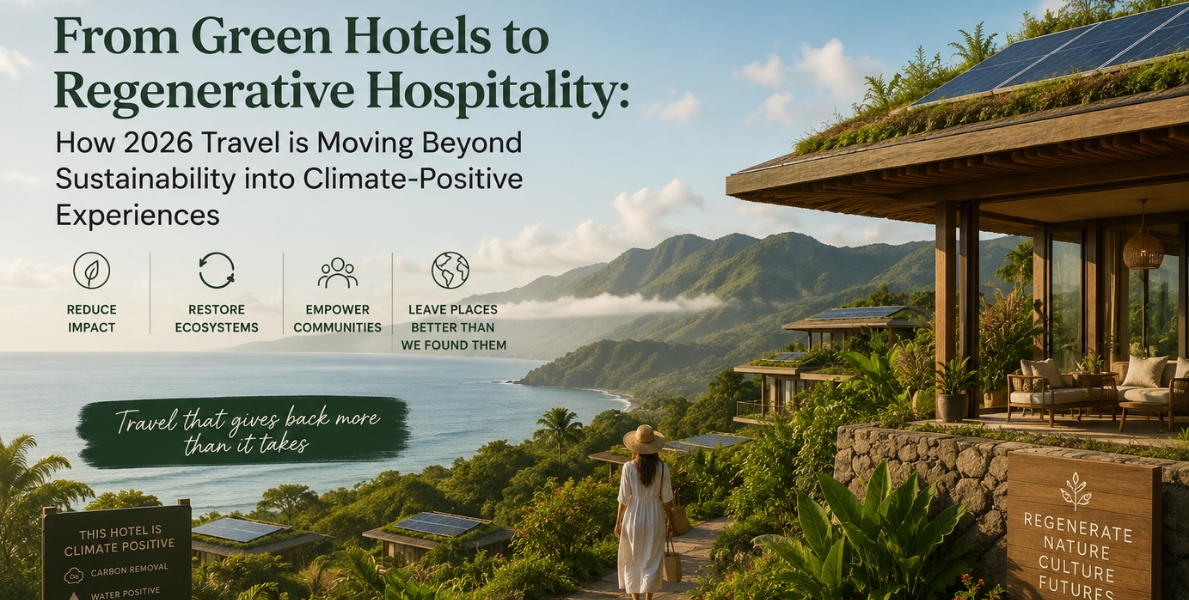
For decades, the hospitality industry operated under a "do no harm" philosophy. This was the era of green hotels, characterized by placards asking guests to reuse towels and the replacement of plastic straws with paper ones. While these were necessary first steps, the environmental landscape of 2026 has rendered simple sustainability insufficient. Today, the travel industry is undergoing a seismic shift toward regenerative hospitality—a model that doesn't just minimize impact but actively heals the ecosystems and communities it touches.
As we navigate this new era, the demand for visionaries in the field has never been higher. Those looking to lead this change often begin their journey through an international hotel management course, where the curriculum has evolved from basic service standards to complex environmental stewardship.
Defining the Shift: Sustainability vs. Regeneration
Sustainability is about maintenance; it is the attempt to keep a system from degrading further. Regeneration, however, is about restoration and growth. In the context of 2026 travel, a sustainable hotel might use solar panels to offset its energy use. A regenerative hotel, by contrast, is designed as a carbon sink, producing more renewable energy than it consumes and feeding the excess back into the local municipal grid.
This evolution is driven by a more "climate-conscious" traveler. Modern tourists are no longer satisfied with carbon offsets that feel like distant abstractions. They want to see the physical evidence of their footprint being erased. They seek out properties that plant mangroves to prevent coastal erosion, hotels that utilize greywater to reforest arid landscapes, and resorts that prioritize indigenous architectural techniques to naturally regulate temperature.
The Pillars of Regenerative Hospitality in 2026
1. Carbon-Negative Architecture
In 2026, the most prestigious buildings are no longer defined by glass and steel but by living materials. We are seeing the rise of "bio-facture"—using mycelium (mushroom roots) for insulation and hempcrete for walls. These materials sequester carbon throughout their lifespan. Hotels are being reimagined as vertical forests, where every balcony and rooftop is a functional habitat for local pollinators.
For students at the best hospitality colleges in Kolkata, understanding the intersection of urban design and guest experience is becoming a core competency. Learning how to manage a high-tech, eco-integrated facility in a bustling metropolis requires a unique blend of traditional hospitality and environmental science.
2. Hyper-Local Food Systems
The "farm-to-table" trend of the 2010s has matured into "circular foraging." Regenerative resorts now feature onsite permaculture farms that utilize composted guest food waste as nutrient-rich soil. In 2026, a guest's dinner menu isn't just determined by what is in season, but by what the local soil needs to be planted next to maintain its nitrogen balance. This circularity reduces the carbon heavy-lifting of long-range logistics and ensures that the hotel supports local biodiversity.
3. Community Wealth Building
True regeneration includes the human element. The old model of "resort enclaves"—where luxury sat behind a wall while the local community remained stagnant—is dying. Regenerative hospitality integrates the community into the supply chain. This means hotels are investing in local artisans, providing education, and ensuring that tourism dollars are distributed equitably. It is about leaving a destination better off socially and economically than it was before the hotel opened.
The Role of Education in a Climate-Positive World
The transition from green to regenerative requires a complete overhaul of how we train the next generation of industry leaders. Managing a climate-positive hotel is infinitely more complex than managing a traditional one. It requires knowledge of renewable energy systems, waste-to-resource technologies, and empathetic community engagement.
In regions experiencing rapid growth, such as Northeast India, the educational infrastructure is rising to meet this challenge. Aspiring professionals at a hotel management college in Guwahati are now being trained to handle the specific ecological sensitivities of the Himalayan foothills and the Brahmaputra basin. They are learning that hospitality in 2026 is as much about conservation as it is about concierge services.
Technology as an Enabler of Regeneration
Artificial Intelligence and the Internet of Things (IoT) play a silent but vital role in climate-positive experiences. In 2026, smart sensors can adjust room environments based on real-time outdoor conditions, reducing energy waste to near zero. Blockchain technology is being used to provide guests with "Transparency Passports," allowing them to trace the origin of every ingredient on their plate and every liter of water used during their stay.
Furthermore, digital platforms now allow guests to participate in regenerative efforts. Travelers can join "citizen science" programs hosted by hotels—mapping coral reefs during a scuba dive or participating in wildlife census counts. This transforms the guest from a passive consumer into an active contributor to the destination's health.
Case Studies: The New Gold Standard
Across the globe, we see examples of this movement in action:
- The Rewilding Retreats of Rwanda: Luxury lodges that have successfully reintroduced endangered species into former agricultural lands, creating a thriving ecosystem that sustains both wildlife and high-end tourism.
- The Floating Solar Cities of the Maldives: Resorts that act as floating power plants, providing clean energy to neighboring inhabited islands while utilizing underwater structures to accelerate coral growth.
- The Urban Oases of Singapore: Hotels that function as "air purifiers" for the city, using massive green walls to scrub CO2 and pollutants from the urban atmosphere.
Why "Green" Is No Longer Enough
The urgency of the climate crisis has shifted the definition of luxury. In the past, luxury was defined by excess—over-the-top buffets, high-flow showers, and air conditioning set to freezing temperatures. In 2026, luxury is defined by "guilt-free indulgence." Travelers want the highest level of service, but they want it to come from a place of integrity. They want to wake up in a room that breathes, eat food that heals the earth, and leave a destination knowing their presence contributed to its flourishing.
This shift is not just ethical; it is an economic necessity. Properties that fail to adapt to regenerative standards are finding it harder to secure insurance, investment, and, most importantly, guests. The "greenwashing" of the past—where a hotel claimed sustainability while changing little of its core operation—is now easily unmasked by savvy, tech-enabled travelers.
Future Outlook: The Path Forward
As we look toward the end of the decade, the goal is for "regenerative" to become the baseline rather than the exception. This will require continued collaboration between governments, technology providers, and educational institutions.
The leaders of tomorrow—those currently studying at the best hospitality colleges in Kolkata or pursuing an international hotel management course—will be the ones to implement these systems at scale. They will be the architects of a world where travel is a force for global healing.
Conclusion
Travel has always been about transformation—how a journey changes the traveler. In 2026, the focus has expanded to include how the journey changes the world. Regenerative hospitality is the ultimate expression of this idea. By choosing climate-positive experiences, we ensure that the beautiful destinations we love today will not only exist for future generations but will be more vibrant, diverse, and resilient than ever before. The era of the "taker" is over; the era of the "restorer" has begun.