
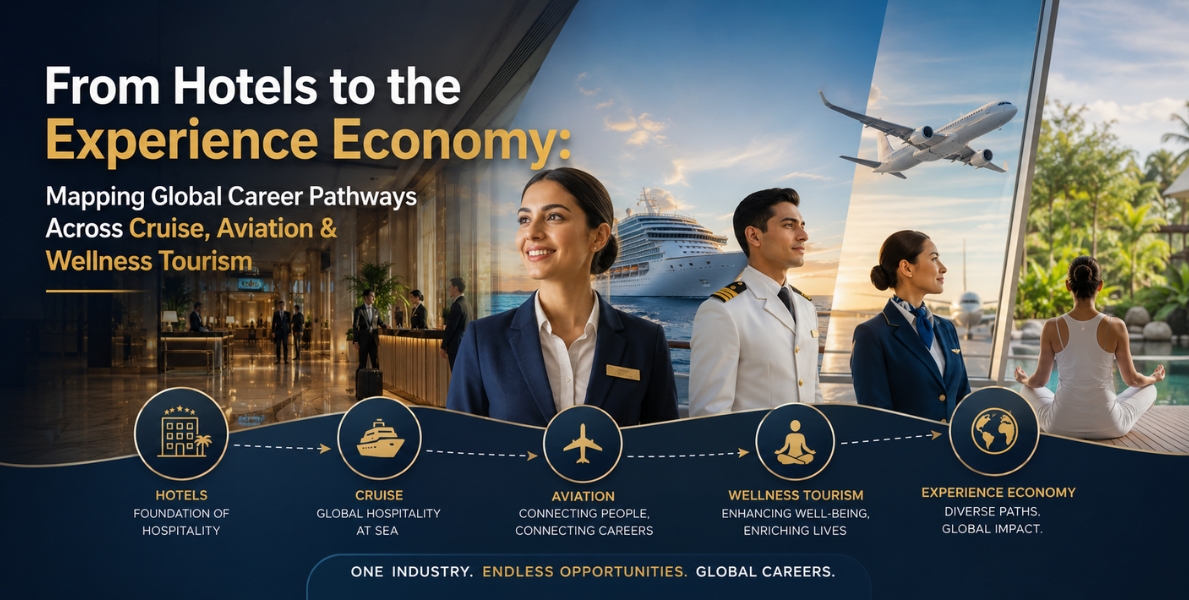
The old-school definition of hospitality was simple: a clean room, a comfortable bed, and a smooth check-in. But that box is way too small for what's happening in the world right now. Travelers aren't looking for a place to crash anymore; they are chasing transformation. We are living in a full-blown experience economy, where the traditional skills of hotel management have spilled out of the lobby and into completely different playgrounds—luxury cruise liners, premium aviation cabins, and multi-billion-dollar wellness retreats.
The world has broken wide open, and the skill sets required to run it have evolved. If you look at a modern BSc Hons International Tourism and Hospitality Management program, you'll see the focus has completely pivoted. It's no longer just about front-office operations; it's about understanding cross-border logistics, cultural psychology, and the art of managing human experiences at 30,000 feet or in the middle of the ocean.
The Cruise Ship: A Floating City of Micro-Experiences
A modern cruise liner isn't just a boat; it's a hyper-dense, floating luxury resort, theme park, and culinary hub all wrapped into one. Managing operations on a ship is hospitality on overdrive. You are dealing with a captive audience for days or weeks at a time, which means your execution has to be flawless.
Career tracks here have expanded massively:
- Guest Experience Directors: Moving beyond traditional guest relations to curate week-long entertainment, dining, and shore excursion ecosystems.
- Marine Hotel Officers: Managing massive supply chains and cross-cultural crew dynamics while sailing through international waters.
Because the logistics are so intense, this sector is hungry for talent that understands global compliance and high-pressure operations. Young professionals stepping out of a structured hospitality and tourism course in Guwahati are finding that their training in regional logistics and resource management translates perfectly to the demanding, high-reward environment of international cruise lines.
Aviation: Elevating the Concierge to the Skies
The aviation industry has realized that legroom isn't the only way to win over premium passengers. The real differentiator is the service ecosystem. First and business-class cabins are being designed to mimic boutique hotels, featuring private suites, onboard lounges, and curated dining.
This has changed the trajectory for hospitality professionals. Major global airlines actively recruit hotel school graduates for roles that go far beyond standard cabin crew duties:
- In-Flight Service Managers: Acting as flying hotel managers, responsible for maintaining premium brand standards and handling complex passenger dynamics in high-altitude environments.
- Premium Lounge Operations: Managing VIP airport hubs that feature fine dining, spa facilities, and private workspaces.
Wellness Tourism: The Intersection of Health and Hospitality
Perhaps the fastest-growing frontier in the experience economy is wellness tourism. People are traveling specifically to heal, decompress, and reset. This has triggered a massive convergence between luxury resorts, medical science, and holistic health.
We are seeing a surge in demand for specialized roles like:
- Wellness Retreat Directors: Professionals who can seamlessly coordinate between nutritionists, therapists, and traditional resort staff to deliver a cohesive, restorative guest journey.
- Spa and Longevity Hub Managers: Overseeing high-tech, high-touch facilities that merge clinical efficiency with luxury service standards.
In major educational hubs, training programs are adapting to this shift. For instance, students pursuing a BSc in Hotel Management in Kolkata are no longer just learning standard food and beverage or accommodation operations. They are being trained to manage complex service blueprints that cater to the lifestyle, health, and emotional needs of an increasingly demanding global clientele.
The Core DNA of the Experience Economy
Whether you are managing a wellness retreat in the hills, a luxury cabin in the sky, or a massive cruise liner at sea, the fundamental currency is the same: empathy, data-driven personalization, and the ability to handle chaos with grace.
The lines between sectors have officially blurred. The skills learned in a global classroom don't lock you into a single building anymore; they give you a passport to the entire global service landscape. By looking past the traditional four walls of a hotel, future professionals can position themselves at the very center of how the world chooses to live, travel, and explore.