
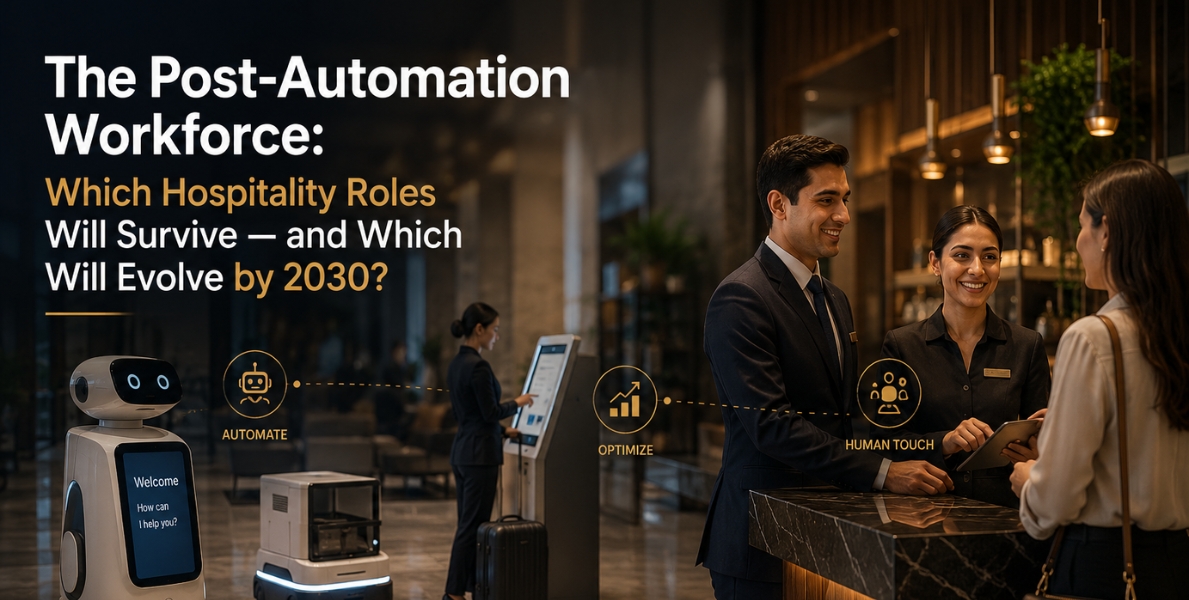
The hospitality landscape is undergoing its most significant technological disruption since the advent of online booking engines. As we move closer to 2030, artificial intelligence, robotics, and hyper-automated property management systems are transitioning from premium novelties into baseline operational standard utilities. Automated check-in kiosks, AI-driven guest communication bots, and robotic kitchen assistants are fundamentally changing how properties run.
This shift leaves many industry hopefuls and current professionals asking a critical question: What happens to the human workforce?
The answer isn't a total displacement of human capital, but rather a profound reallocation of talent. While automation handles repetitive, data-driven, and mechanical tasks, the demand for authentic human connection, strategic oversight, and specialized creative skills is skyrocketing. Preparing for this landscape requires a strategic foundation, which many acquire through an international hospitality course designed to address these upcoming systemic shifts.
The Roles Facing Full Automation: Routine and Data Handling
By 2030, roles that rely heavily on repetitive data entry or predictable physical tasks will largely be absorbed by software and machinery.
Front-desk administrative agents are rapidly evolving into digital guest experience managers. Basic check-ins, key allocations, and billing disputes are highly optimized via mobile apps and biometric kiosks. Similarly, basic night auditor positions, which historically focused on reconciling financial data from the day's operations, are now almost entirely handled by real-time automated accounting APIs.
Even within environmental services, routine floor cleaning and heavy laundry sorting are increasingly managed by automated systems, allowing human teams to focus on specialized sanitization protocols and room customization.
The Resilient Roles: Creative Arts and Cultural Curation
While a machine can perfectly replicate a data pattern or follow a rigid mechanical path, it cannot replicate human creativity, sensory intuition, or cultural storytelling. This reality secures the future of specific, highly specialized sectors within the industry.
The Culinary Arts
The kitchen is a prime example of human resilience against automation. While automation can assist with ingredient prep or inventory tracking, it cannot replace the nuanced palate of a master chef, the artistic execution of a complex dish, or the ability to innovate flavor profiles based on local, seasonal inspirations.
In emerging culinary hubs, this distinct human advantage is driving significant educational growth. Aspiring culinary professionals training at the best culinary arts colleges in Guwahati are focusing less on mechanical repetition and more on gastronomic innovation, sustainable sourcing, and regional culinary preservation—skills that algorithms cannot simulate.
Destination Experts and Cultural Curators
Standard sightseeing itineraries are easily generated by AI. However, deep cultural storytelling, hyper-customized local networking, and the ability to pivot an experience based on a traveler's real-time emotional response remain exclusively human traits.
Because of this, the travel and tourism sector is seeing a massive surge in demand for experiential itinerary designers. Individuals enrolling in tourism courses in Kolkata are being trained to operate as heritage consultants and cultural curators rather than simple booking agents. They learn to design deep-tier regional experiences that provide the emotional depth modern travelers crave.
The Evolved Roles: The Rise of the Tech-Empowered Human
The most substantial segment of the 2030 workforce will belong to roles that do not disappear, but instead undergo a radical transformation. These professionals will use automation as an accelerator rather than competing against it.
The Modern Concierge as a Lifestyle Architect
The concierge of 2030 will no longer spend time booking restaurant reservations or hailing taxis—tasks that guests can execute seamlessly via room-integrated smart assistants. Instead, the concierge will act as a holistic lifestyle architect. Armed with predictive AI analytics that outline a guest's historical preferences, dietary restrictions, and wellness goals, the modern concierge will curate deeply personalized wellness, business, or leisure ecosystems throughout the guest's stay.
Revenue Managers turned Strategic Data Analysts
Revenue management has already shifted away from manual spreadsheet updates. By 2030, dynamic pricing algorithms will adjust room rates every second based on global flight data, local weather changes, and real-time competitor occupancy. The human revenue manager's role will evolve into high-level strategy: setting the ethical boundaries of pricing algorithms, managing corporate B2B contracts, and aligning financial models with long-term brand equity.
Preparing for the 2030 Workforce
To remain indispensable in a post-automation world, the hospitality professional must focus on developing two distinct skill sets:
- High-Level Emotional Intelligence (EQ): Conflict resolution, cultural empathy, and intuitive hospitality that makes a guest feel distinctly valued.
- Technological Literacy: The ability to manage, audit, and direct the automated systems handling the property's operational heavy lifting.
Educational institutions are restructuring their programs to reflect this duality. Comprehensive training through an international hospitality course no longer just teaches the mechanics of running a hotel; it focuses on leadership, data-driven decision-making, and advanced human-to-human service paradigms.
Whether mastering the creative nuances of gastronomy at the best culinary arts colleges in Guwahati or learning to navigate global heritage travel trends via tourism courses in Kolkata, the mandate for the future workforce is clear. Automation is not removing the humanity from hospitality—it is stripping away the mechanical monotony so that humans can finally focus entirely on the art of hosting.